Pyramids & tombs · Beni Suef
The Pyramids of Meidum
A towering ruin where pyramid design changed forever
- City
- Beni Suef
- Type
- Pyramids & tombs
- Era
- Old Kingdom, c. 2600 BC (late 3rd–early 4th Dynasty)
Overview
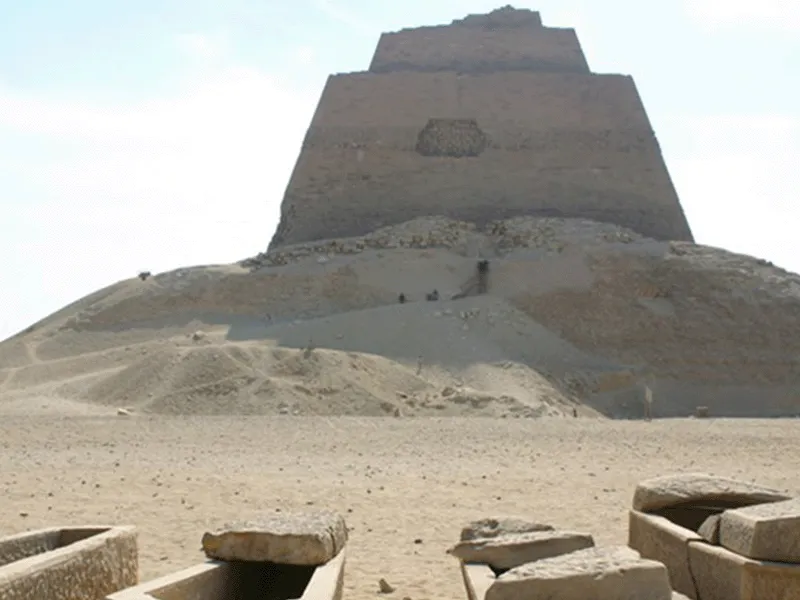
The Meidum Pyramid rises from the desert edge in Beni Suef Governorate, roughly 100 kilometres south of Cairo, overlooking the western fringe of the Nile Valley. Today it appears as a tower-like core of stepped masonry standing above a great mound of rubble, which gives it one of the most distinctive silhouettes in Egypt. Its unusual shape records an ambitious building project that was reworked more than once at the end of the Third Dynasty and the start of the Fourth.
Most scholars associate the monument with King Huni, the last ruler of the Third Dynasty, and with his successor Sneferu, who is generally credited with completing it. It began as a stepped structure and was later enlarged and given smooth, sloping sides, an important experiment in the move from step pyramids to true pyramids. The outer casing and upper layers later failed, exposing the inner core that visitors see today.
Around the pyramid lie a small mortuary temple, a causeway and mastaba tombs of Old Kingdom elites. The chapel of the mastaba of Nefermaat and Atet yielded the famous painting known as the Meidum Geese, while statues of Prince Rahotep and his wife Nofret are celebrated works of early Egyptian sculpture. These treasures are now in the Egyptian Museum in Cairo. Excavations by Flinders Petrie in the early 1890s helped shape the modern study of the site.
What to see
- 01The tower-like core of the pyramid, a visible record of its stepped and later smooth-sided phases
- 02The small mortuary temple on the pyramid's eastern side and the remains of its causeway
- 03The mastaba of Nefermaat and Atet, source of the celebrated Meidum Geese painting
- 04Surrounding Old Kingdom mastabas, including the tomb area linked to Prince Rahotep and Nofret
Visitor tips
- Confirm current access and opening arrangements with local tourism authorities before travelling, as conditions at remote sites can change.
- Bring water, sun protection and sturdy shoes, since the site is exposed desert with little shade and uneven ground.
- Pair the visit with the Fayoum region or the pyramids of Dahshur, and see the Meidum statues and painting at the Egyptian Museum in Cairo.
Frequently asked questions
Who built the Meidum Pyramid?
It is generally linked to King Huni, last ruler of the Third Dynasty, and King Sneferu of the Fourth Dynasty, who is usually credited with completing and transforming it.
Why does the Meidum Pyramid look like a tower?
Its outer casing and upper layers collapsed over time, leaving the inner stepped core exposed above a large mound of fallen debris.
Where is the Meidum Pyramid located?
It lies near the edge of the desert in Beni Suef Governorate, roughly 100 kilometres south of Cairo, on the western side of the Nile Valley.