Pyramids & tombs · Giza · Most visited
Giza plateau
Where the last ancient wonder still stands
- City
- Giza
- Type
- Pyramids & tombs
- Era
- Old Kingdom, Fourth Dynasty, c. 2600–2500 BC
Overview
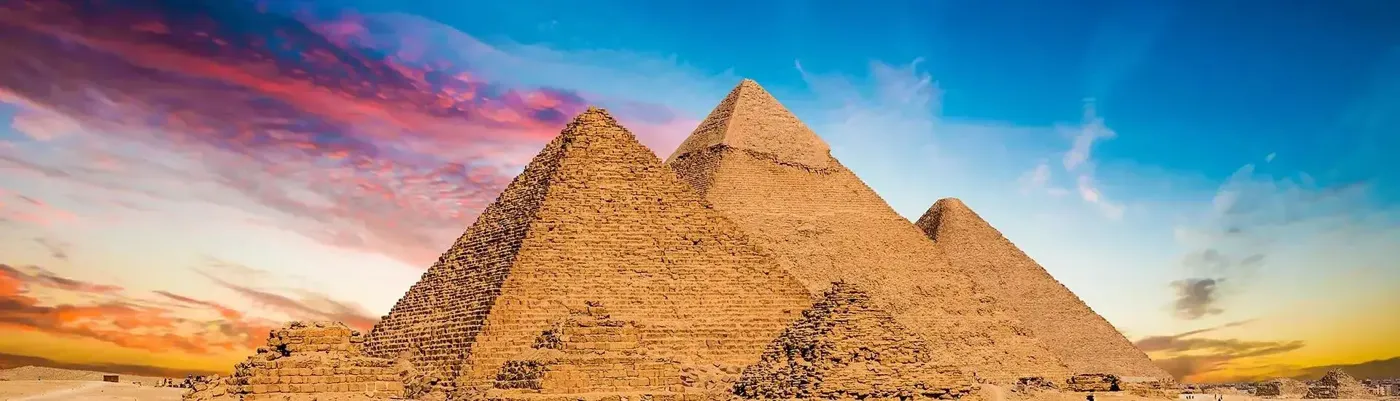
The Giza plateau is a limestone desert plateau on the west bank of the Nile, on the edge of modern Cairo, and it is home to the best-known monuments of ancient Egypt. In the Fourth Dynasty of the Old Kingdom, around the 26th century BC, kings chose this high ground to build their royal tombs. The result is a vast necropolis of pyramids, temples, causeways and cemeteries that has fascinated travellers for thousands of years.
Three main pyramids dominate the site, built for the kings Khufu, Khafre and Menkaure. The Great Pyramid of Khufu is the largest and the only one of the Seven Wonders of the Ancient World still standing. It originally rose to about 146 metres, though erosion and the loss of its outer casing have reduced it to roughly 138 metres. Smaller pyramids for royal women and the family tombs of officials surround the three giants.
The Great Sphinx, carved from the natural bedrock and generally linked to the reign of Khafre, guards the eastern edge of the plateau near the valley temple. Archaeologists have also uncovered the settlements and cemeteries of the builders to the south, showing they were organised Egyptian workers rather than the slaves of popular legend. Together with Memphis and the other pyramid fields, Giza was inscribed on UNESCO's World Heritage List in 1979.
What to see
- 01The Great Pyramid of Khufu, the largest pyramid at Giza and the last surviving wonder of the ancient world
- 02The pyramids of Khafre and Menkaure, with their causeways and temples
- 03The Great Sphinx and its neighbouring valley temple carved and built from local limestone
- 04The cemeteries of nobles and the small queens' pyramids around the main pyramids
Visitor tips
- Arrive early in the day when it is cooler and quieter, and bring sun protection, water and comfortable walking shoes for sandy, uneven ground.
- Check official sources for current opening hours, ticket rules and which pyramid interiors are open, as access inside the monuments can be limited or change.
- Agree the price of any camel, horse or guide service clearly before you start, and buy tickets only from official ticket offices.
Frequently asked questions
Who built the pyramids of Giza and when?
The three main pyramids were built for the Fourth Dynasty kings Khufu, Khafre and Menkaure, in the 26th century BC. Evidence from the workers' towns and tombs shows they were built by organised Egyptian labourers.
Is the Great Pyramid still one of the Seven Wonders of the Ancient World?
The Great Pyramid of Khufu is the oldest of the Seven Wonders of the Ancient World and the only one that still survives, although it has lost its smooth outer casing and some of its original height.
Who does the Great Sphinx represent?
The Sphinx is a lion's body with a human head, carved from the plateau's bedrock. It is generally associated with King Khafre, whose pyramid complex lies close by.