Overview
Luxor Temple (معبد الأقصر) stands on the east bank of the Nile in the middle of modern Luxor, ancient Thebes. Unlike many Egyptian temples, it was not mainly a place for a god's daily cult or a king's funerary memory. It was devoted to the renewal of royal kingship and linked to the Theban triad of Amun-Ra, Mut and Khonsu. Its ancient name is usually translated as the "Southern Sanctuary," and it was closely tied to the annual Opet Festival.
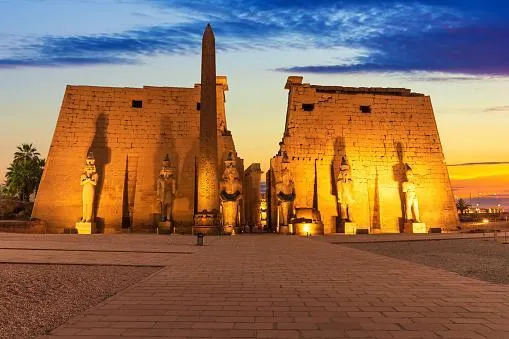
Most of the core temple was built under Amenhotep III in the 14th century BC, including the great sun court, the inner halls and the sanctuaries. The processional colonnade was decorated with scenes of the Opet Festival under Tutankhamun and later Horemheb. Ramesses II then added a monumental pylon, a forecourt and colossal statues of himself. Alexander the Great is associated with a rebuilt barque shrine, showing how the temple kept evolving across dynasties.
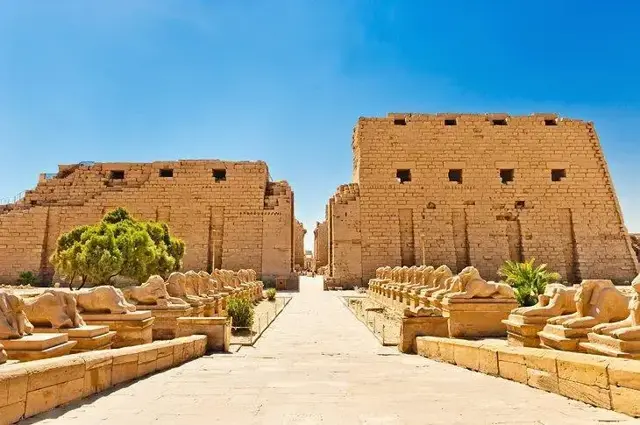
The temple's life continued long after the pharaohs. In the Roman period part of it became a military camp, and one chamber was decorated for the imperial cult. Later, sand and houses covered much of the site, and a mosque dedicated to Sheikh Yusuf Abu al-Haggag was built over the forecourt, where it still stands. Clearance work in the 19th and 20th centuries revealed the temple, and the restored Avenue of Sphinxes now links it with Karnak.
What to see
- 01The Ramesses II pylon, with colossal statues and a single standing obelisk at its entrance
- 02The processional colonnade, with tall papyrus-style columns and Opet Festival reliefs
- 03The sun court of Amenhotep III, framed by rows of papyrus-bundle columns
- 04The Abu al-Haggag Mosque above the forecourt and the Roman-era imperial cult chamber
Visitor tips
- Check current opening hours and ticket prices on official sources before you go, as they can change.
- Visit in the late afternoon or evening if possible: the temple is lit after dark and the heat is gentler.
- Combine your visit with Karnak Temple, and bring water, a hat and comfortable shoes for the stone paving.
Frequently asked questions
Who built Luxor Temple?
Most of the core temple was built by Amenhotep III in the 14th century BC. Tutankhamun and Horemheb contributed to the colonnade decoration, and Ramesses II added the front pylon and forecourt. Later rulers, including Alexander the Great, also left additions.
Where is the second obelisk of Luxor Temple?
Originally two obelisks stood before the pylon. One remains in Luxor, while the other was given by Egypt's ruler Muhammad Ali Pasha to France and now stands in the Place de la Concorde in Paris.
How is Luxor Temple connected to Karnak Temple?
The two temples were linked in antiquity by a ceremonial road lined with sphinxes, used in the Opet Festival. The Avenue of Sphinxes, about 2.7 km long, has been restored and opened to visitors, though you should check current access.