Pyramids & tombs · Giza
Dahshur
Where Egypt's pyramid builders perfected the true pyramid
- City
- Giza
- Type
- Pyramids & tombs
- Era
- Old & Middle Kingdoms, c. 2600–1800 BC
Overview
Dahshur is a royal necropolis on the desert edge of the Nile's west bank, roughly 40 kilometres south of Cairo in Giza Governorate and just south of Saqqara. It belongs to the Memphis and its Necropolis area, inscribed on the UNESCO World Heritage List in 1979. Its pyramids span the Old and Middle Kingdoms, and the open, uncrowded desert setting makes it a calmer alternative to the Giza Plateau for visitors who want space to take in the monuments.
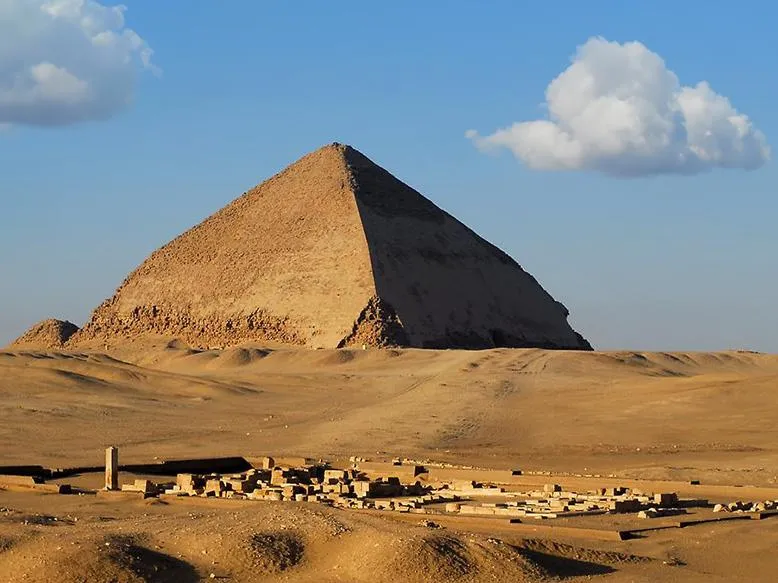
The site is best known for the two great pyramids of King Sneferu, founder of the Fourth Dynasty, built around 2600 BC. The Bent Pyramid, named for the change in slope halfway up its sides, still retains much of its smooth outer limestone casing. The Red Pyramid, named for the reddish tint of its stone, is widely regarded as Egypt's first successful true smooth-sided pyramid and is among the largest in the country.
Dahshur also preserves pyramids of Middle Kingdom rulers, including Amenemhat II, Senusret III and Amenemhat III. The Black Pyramid of Amenemhat III, built with a mudbrick core, now survives as a weathered, ruined mound. In the 1890s, excavations by Jacques de Morgan uncovered the burials of royal women near these pyramids, with remarkable jewellery that is now counted among the finest examples of Middle Kingdom craftsmanship.
What to see
- 01The Bent Pyramid of Sneferu, with its dramatic change of angle and well-preserved limestone casing
- 02The Red Pyramid, an early true pyramid, with its tall interior corbelled chambers
- 03The ruined Black Pyramid of Amenemhat III and other Middle Kingdom pyramid remains
- 04Wide desert views across the necropolis, with Saqqara's pyramids visible to the north
Visitor tips
- Wear sturdy, comfortable shoes and bring water, sun protection and a hat, as there is little shade across the desert site.
- The passage into the Red Pyramid is steep, low and narrow, and the interior can be warm and stuffy, so consider carefully if you dislike enclosed spaces.
- Check current opening hours, ticket arrangements and interior access locally before you go, and combine Dahshur with Saqqara and Memphis for a fuller day.
Frequently asked questions
Where is Dahshur and how does it relate to Giza and Saqqara?
Dahshur lies on the west bank of the Nile in Giza Governorate, about 40 kilometres south of Cairo and south of Saqqara. Like Giza and Saqqara, it is part of the Memphis and its Necropolis World Heritage area.
Why is the Bent Pyramid called "bent"?
The pyramid's slope changes partway up, giving it a distinctive bent profile. Scholars commonly suggest the builders reduced the angle to improve stability, although the exact reasons are still discussed.
Can visitors go inside the pyramids at Dahshur?
Interior access has been available at times, notably to the Red Pyramid, but conditions can change for conservation or safety reasons. Check current access locally before your visit.