Pyramids & tombs · Alexandria
Catacombs
Alexandria's underground necropolis where three cultures meet
- City
- Alexandria
- Type
- Pyramids & tombs
- Era
- Roman period, 2nd–4th centuries AD
Overview
The Catacombs of Kom el-Shoqafa are among the most distinctive burial complexes in Alexandria and the largest known Roman-era funerary site in the city. Cut into the bedrock in the Karmouz district, they were probably begun in the second century AD as a tomb for one family before expanding to receive many more burials over the following generations. Rediscovered by chance in 1900, they reveal how Alexandria's mixed society expressed belief and identity in death.
Visitors descend a spiral staircase wound around a circular shaft, which was once used to lower the deceased into the tomb. Below lie a rotunda, a banqueting hall with stone couches where relatives held funerary meals, and a main burial chamber with carved sarcophagi and wall niches. The Arabic name means 'Mound of Shards' and is generally explained by the broken pottery that gathered above ground from offerings brought by mourners.
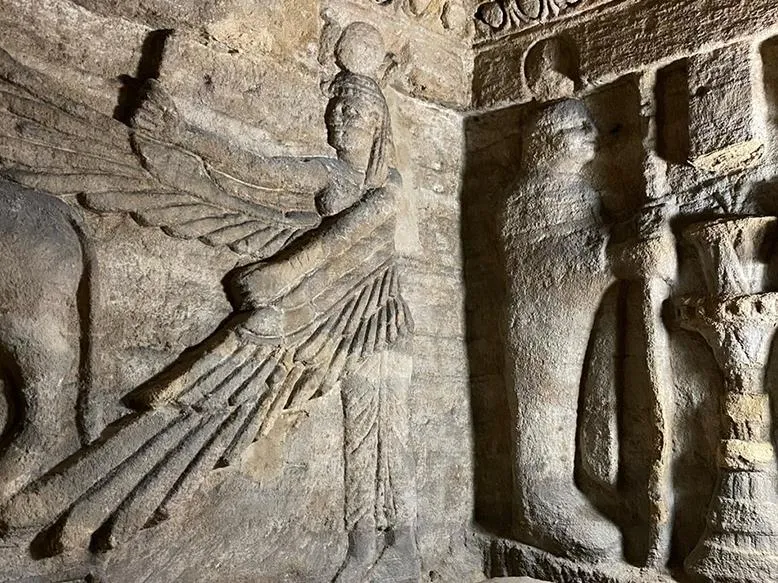
What makes the site famous is its blend of Egyptian, Greek and Roman artistic traditions. Funerary reliefs show Egyptian deities such as Anubis dressed in the style of a Roman soldier, set within Hellenistic architectural forms and decorative motifs. The result is a rare illustration of cultural fusion in Roman Egypt. Parts of the lower levels are affected by groundwater, so the site is best seen as a compact, atmospheric introduction to Alexandria's ancient past.
What to see
- 01The spiral staircase and central shaft used to lower the dead into the tomb
- 02The triclinium, a banqueting hall with stone couches for funerary feasts
- 03The main tomb chamber, with its blend of Egyptian, Greek and Roman reliefs
- 04Carved figures of Anubis in Roman military dress, a symbol of cultural fusion
Visitor tips
- Wear comfortable shoes with good grip, as the stairs and passages can be narrow, uneven and damp.
- Check current opening hours, ticket details and photography rules with official sources before your visit, as these can change.
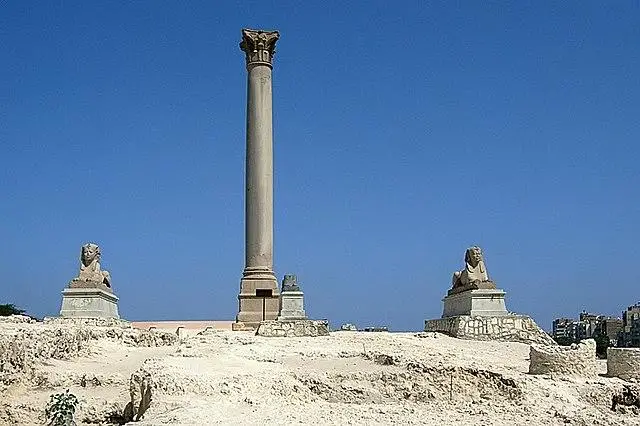
- Pair your visit with nearby Pompey's Pillar and the Serapeum area to see more of Roman-era Alexandria in one outing.
Frequently asked questions
What does Kom el-Shoqafa mean?
The Arabic name means roughly 'Mound of Shards' or 'Mound of Potsherds'. It is generally linked to the broken pottery that piled up in the area from vessels used for offerings and funerary meals.
When and how were the Catacombs of Kom el-Shoqafa discovered?
They were found by chance in 1900, reportedly when a donkey fell into a hidden shaft. The complex dates mainly to the Roman period, from about the second century AD, and was used for some centuries.
Why are the Catacombs of Kom el-Shoqafa so famous?
They combine Egyptian, Greek and Roman art and architecture in a single tomb. Reliefs such as Egyptian gods in Roman-style dress show how Alexandria's mixed culture shaped its funerary traditions.